Skip to content

Driving licence

Theory test

Prepare yourself realistically and successfully for the theory driving test. Our preparation for the theory test is based on the test format on the PC and helps you to understand and master the original test questions, video scenarios and test logic. With TÜV NORD, you are ideally equipped - for your exam success.

Simulate original test
Fahrschüler beantwortet theoretische Führerschein-Fragen am PC

Practical tips for the theory test

With good preparation, you can almost pass the theory driving test. If you have successfully completed the questionnaires at the driving school, you can go into the test relaxed. The test is conducted on a PC and contains exactly the same questions that you know from the lessons.

Fit for the theory test - what you need to know

The aim of the training is to make you a safe, responsible and environmentally aware road user. Theoretical knowledge is essential for this.

Lesson structure:

  • The lessons are organised in units of 90 minutes (double lessons).
  • It consists of a general part that is the same for all classes (basic material) and a class-specific part (additional material).

Minimum scope:

  • First-time acquisition of the driving licence: 12 double hours in the basic material.
  • If you previously held a driving licence: at least 6 double hours in the basic material.
  • Additional material: Between 2 and 18 double hours are required, depending on the driving licence category and previous possession.

Important note: You can only register for the test once all the specified training objectives have been achieved and confirmed by your driving school.

What documents do you need for the theory test?

  • Confirmation of appointment: Arrange a test date via your driving school.
  • Proof of identity: Bring a valid identity card or passport.
  • Training certificate: Present the certificate of completion of theoretical training issued by your driving school.
  • Proof of payment: A bank statement as proof of the examination fees paid is required.

Procedure of the theory test

  • Punctuality: Arrive at the examination venue on time at the agreed date.
  • Examination authorisation: A TÜV NORD employee will check whether you are authorised to take the exam. Your identity and training qualification will be checked and you will be allocated a PC test station.
  • Test start: You will see your name and the driving licence category to be tested on the screen. An explanatory programme can be viewed or skipped.
  • Answering questions: You have enough time to answer the test questions. You decide yourself when to finalise the questionnaire.
  • Automatic selection: The questions correspond to the valid learning programme and are automatically selected by the system.
  • Result: After the test, you will receive the result report by email and via the TÜV NORD learner driver app.

What happens after the theory test?

If you pass - theory test passed

Congratulations! You have passed the theory driving test.

Your results report will be made available to you by email and via the TÜV NORD learner driver app.

Share the positive result with your driving school and now concentrate on the practical test.

Failed theory test

There are worse things! Let your driving school know the test result.

When you feel ready, arrange a new test date via your driving school. Please note that you can only take the test again after 14 days at the earliest.

The retest is subject to a fee. Please pay the test fee on receipt of the invoice and bring proof of payment and your valid ID with you. You're sure to pass!


Person bei der theoretischen Führerscheinprüfung am Computer

Realistic traffic situations in the theory test

Since 2014, videos have been an integral part of the theoretical driving test. These short films prepare learner drivers more realistically for critical traffic situations by depicting the scenes as they occur in real road traffic.

The computer-animated videos, which last around 15 seconds, show realistic scenarios. Examples include a cyclist suddenly emerging from a blind spot, a child playing at the side of the road or complex crossing situations involving several road users. The dynamics of these scenes are conveyed much better in a video than through static images or graphics.

Although the total number of exam questions has remained the same, the question catalogue now contains up to three video tasks within the 30 questions. As an examinee, you have the option of watching the video sequences up to five times before answering the corresponding question.

Thanks to the flexible computer animation, the clips can be customised so that there are always new scenarios with different landscapes, road layouts or vehicles. These variations challenge you as the examinee to analyse the situations and react appropriately.

Simulate original test

How many error points can you have?

The exam marking is not based on a fixed number of incorrect answers, but on penalty points:

Important rules regarding marking:

  • Each question answered incorrectly incurs between 2 and 5 penalty points, depending on the difficulty.
  • A maximum of 10 penalty points is allowed to pass the exam.
  • Exception: If you get two questions wrong, each worth 5 penalty points, the exam is considered failed despite the maximum of 10 penalty points – this rule is often referred to as the ‘2 × 5-point rule’.

In practical terms, this means: You can afford to make plenty of ‘minor’ mistakes (e.g. on 2- or 3-point questions), but you should be particularly confident with the ‘critical’ 5-point questions – these usually concern dangerous traffic situations involving right of way, distances and hazard perception.
 

How many 5-point questions are there?

There is no fixed rule regarding how many 5-point questions appear in each exam paper – this depends on the question bank and the composition of the paper.

However, these 5-point questions are particularly important because they carry significant weight if answered incorrectly, and getting two 5-point questions wrong can directly prevent you from passing.

10-error-point rule - simply explained

ExampleMark deductionsResult of the theory test
5 + 3 + 210✅ Pass
4 + 3 + 310✅ Passed
5 + 510❌ Failed (two 5-point errors)
5 + 3 + 311❌ Failed (over 10 points)

Questions and error points per driving licence category

Driving licence categoryNumber of exam questionsPermitted number of marks lostNote
Category B30max. 10 penalty pointsBut not 2 × 5-point errors
Class A, A1, A2, AM30max. 10 penalty pointsSame rule as B
Upgrade to a higher category20max. 6 penalty pointswhen obtaining an additional category
Class C (lorries)37max. 10 penalty pointsBut not 2 × 5-point offences
Class D (bus)40max. 10 penalty pointsBut not 2 × 5-point faults

You should know this

Frequently asked questions about the theory test

The theory test for a Class B driving licence (car) consists of 30 multiple-choice questions. These comprise:

  • 20 questions on basic material – general traffic rules for all categories
  • 10 questions on additional Class B material – specific car-related questions

In total, there are 30 questions that must be answered in the test.


If you already hold a driving licence, the number of exam questions is reduced to:

  • 10 questions on basic material
  • 10 supplementary questions


The examination fees for the theory test are set at a standard rate by TÜV NORD – this gives you clear pricing and certainty when planning, regardless of which driving school you attend. Many driving schools charge additional fees for registration and administration, but these vary considerably.

TÜV NORD fees for the theory test:

  • Theory test (all categories): €24.99
  • Theory test for mopeds: €17.26

These prices are set out in the schedule of fees and apply equally to all candidates – regardless of the driving school.

No, as a rule, you cannot simply register for the official theory test on your own without a driving school, and the test itself is not taken entirely online – it takes place in person at an authorised TÜV NORD test centre.

Registering for the test:
In Germany, registration for the theory test is usually handled by your driving school. You must have attended the required number of theory lessons there and received a corresponding training certificate before the driving school can register you for the test.

Direct online registration: Whilst
it is technically possible to book an appointment for the theory test online via the TÜV NORD examination portal, you still need confirmation from your driving school or the training certificate to be admitted to the test. This means: Without a driving school and without this certificate, you will not be admitted to the official test.

Taking the theory test online:
You can prepare for the theory test online or via an app – there are many digital learning systems available to help you practise the questions. TÜV NORD recommends the current question bank.

However, the test itself does not take place entirely online. It is conducted on a PC or tablet at a TÜV NORD test centre; you must attend in person to sit the test.

Yes — there are specific theory tests for different categories of driving licence, which vary in terms of the number of questions and the topics covered. Some special authorisations, such as B196 (125cc without a test), do not require a standard theory test.

Motorcycle theory test (categories A, A1, A2): Motorcycle
licences also have their own theory section with category-specific questions on safe participation in road traffic. The test questions are based on official catalogues.

HGV theory test (categories C, C1, CE):
For heavy goods vehicles, there is a more comprehensive theory section with additional questions on size, weight, load securing and specific traffic situations. As usual, these tests are held at TÜV NORD.

B196 – riding 125cc bikes without a test:
With the B196 code, a car driving licence holder can ride 125cc motorcycles (light motorcycles) without taking a standard theory or practical test. Requirements include a minimum age and special rider training.

125cc bikes without a test in general:
This regulation corresponds exactly to the B196 model in Germany: you do not need to take an additional theory test, but only need to provide proof of training so that the code can be entered.


Yes – the theory test for a driving licence in Germany can be taken in several foreign languages, including Arabic and English. 

The exam questions are translated from the official German question bank into the respective languages.

In addition to Arabic and English, other languages are available, such as French, Turkish, Polish, Spanish, Russian and many more – a total of up to 12 languages are available.

During the registration process, you specify the language in which you wish to take the test. Make sure that this language is confirmed by the test centre before you go to the test.
 

You can find further details on the procedure and language options on our handy information page about the theory test, which includes an overview of all categories and options.

Often, yes – but there are deadlines and conditions. Get in touch with your driving school as soon as possible so that they can change the date correctly.

Many learner drivers are already taking driving lessons at their driving school at the same time. Whether and how this works for you is up to your driving school – ask them what the best approach is.

You won’t automatically receive your standard driving licence card straight after passing your theory test – you’ll only receive it once you’ve passed your practical test and your application for a driving licence has been processed.

Depending on the local authority, this can take anywhere from a few days to several weeks. In many cases, however, the driving licence is available shortly after the practical test or within a few weeks.

If you do not receive your card-style driving licence straight away (e.g. because it is currently being printed), you can apply to the driving licence authority for a provisional driving licence or a certificate of passing the test – this allows you to drive in Germany for a limited period.

Once you have passed the theory test, you have 12 months to pass the practical test – after that, your certificate of passing the theory test expires and you may have to retake it.

Simulate the original theory test - just like on the TÜV PC

Prepare for your driving theory test in a realistic way and for free – exactly as it will be taken later on a computer. With our free, authentic sample test, you’ll answer real questions in the official format and can accurately assess whether you’re ready for the theory test.

✔ Original questions for each driving licence category – in the official exam format
✔ Realistic simulation of the exam structure (20 basic questions + category-specific questions)
✔ Ideal for learning, revising and targeted practice
✔ Free to use – no registration required

Everything you need to know about the driving licence

Find out about the latest developments and useful tips regarding driving licences. You can find further information here.
17-jährige Fahrschülerin bei der Führerscheinprüfung mit Dokumenten

Driving licence at 17

Gain valuable driving experience early on and drive safely on the roads – accompanied by an experienced driver.
Start learning to drive at 17
Fahrprüfung im Auto mit Fahrprüfer und Fahrschülerin

Pass your practical test with confidence

Get fully prepared for your practical driving test – with TÜV NORD’s helpful tips and information, you’ll be well equipped!
Preparing for the practical test
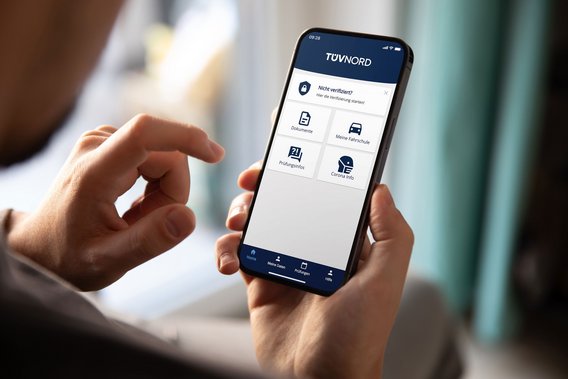
Person nutzt TÜV NORD Fahrschüler-App auf einem Smartphone

Learner driver app

With the TÜV NORD learner driver app, you’ve got everything under control digitally: theory lessons, test dates, directions and your documents.
Find out more about the learner driver app

Contact

We look forward to receiving your inquiry!

TÜV NORD Mobilität

Driver's license and driving permit